
The FullMAX Architecture
How a Narrowband Breakthrough Catalyzed a $4.7B Defense and Autonomous Powerhouse

In the world of technology holding companies, the path from a micro-cap research shop to a multi-billion-dollar enterprise is rarely a straight line. For **Ondas Inc. (NASDAQ: ONDS)**, that journey is an absolute masterclass in strategic leverage.
At the center of Ondas’ transformation from a niche industrial telecom developer into a **$4.7 billion** multi-domain autonomous defense and intelligence giant is a single, foundational invention: **FullMAX**.
By capitalizing on a highly specific spectrum windfall, FullMAX didn’t just solve a massive problem for heavy industry—it provided the architectural foundation and financial runway for an aggressive acquisition spree that has completely reenergized the company.
## The Spark: How FullMAX Broke the Paradigm
To understand the rise of Ondas, you have to look back to the collapse and subsequent rebanding of Nextel Communications in the 2000s and 2010s. When the FCC reassigned clean, interference-free frequencies in the sub-1 GHz bands (like 800 MHz) to critical infrastructure operators like Class I railroads and electric utilities, it left them with a severe technical bottleneck: **the spectrum was licensed, highly secure, and deeply fragmented into narrow channels.**
Traditional wideband communications like commercial LTE or Wi-Fi require large, continuous blocks of spectrum to operate. They are completely useless inside narrow chunks of 100 kHz or 1 MHz.
Ondas stepped into the void with FullMAX—a multi-patented, Software-Defined Radio (SDR) platform engineered to perform “spectrum harvesting.” It took fragmented, narrowband frequencies and digitally aggregated them into a single, high-capacity, secure, IP-based private data pipe. Adopting the global **IEEE 802.16s** standard, FullMAX allowed utilities and railroads to run mission-critical automation across massive geographic footprints (up to 30 miles in radius from a single tower) without paying third-party cellular bills or risking public network downtime.
However, owning an unbreakable, long-range digital pipeline is only half the battle. The true genius of Ondas’ leadership was realizing that the pipeline was an invitation to build a macro-level, automated ecosystem. FullMAX became the cash-generating, relationship-driving engine that funded a massive consolidation wave.
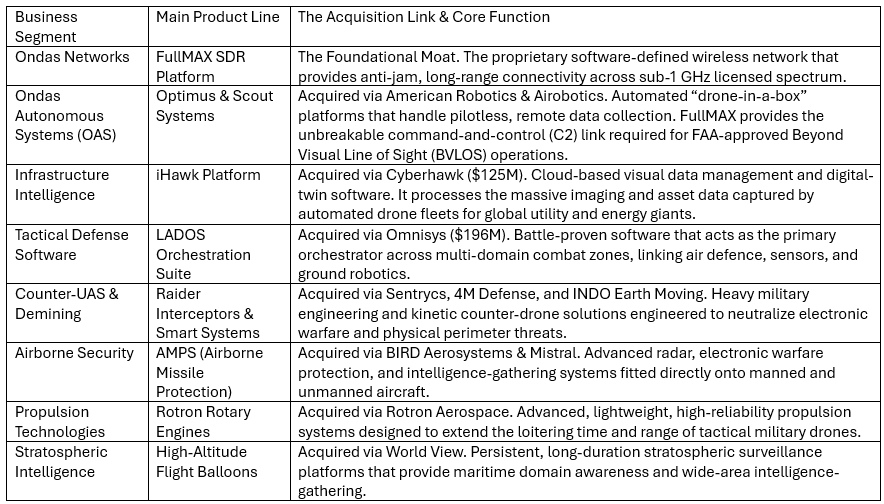
## Connecting the Links: The Ondas Product & Acquisition Portfolio
By leveraging its deep relationships with heavy industry and a massive influx of capital, Ondas systematically went shopping. Each acquisition was selected not just for its standalone revenue, but because it could plug directly into the secure FullMAX communications backbone.
## The Ondas Mission
> To connect, automate, and protect critical infrastructure and national security through a unified, multi-domain autonomous intelligence platform.
Ondas does not view itself as a loose collection of hardware companies. Its objective is to build a comprehensive, software-defined operational consciousness. Whether monitoring a thousand miles of electrical grid in California, scanning a remote maritime border for the U.S. Navy, or orchestrating a contested airspace in Western Europe, the company’s goal is to handle the entire lifecycle of data: **Sensing, Collecting, Transporting, and Analyzing.**
## The “Right to Win”
Ondas’ right to win in a hyper-competitive, dual-use technology market rests on three structural pillars:
### 1. Full-Stack Data Ownership
Most drone companies just build the aircraft; most software companies just write the analytics engine; most telecom companies just sell the radio. Ondas owns the entire vertical chain. They provide the sensor that collects the data (Airobotics/World View), the visualization platform that analyzes it (Cyberhawk), and the highly defensible software that orchestrates it (Omnisys).
### 2. The Unbreakable Pipeline
In a high-intensity electronic warfare environment or an industrial disaster zone, public cellular networks fail and standard radio signals are jammed. Because Ondas owns FullMAX, its autonomous systems are the only platforms in the market backed by a proprietary, anti-jam, low-frequency, software-defined digital pipeline. They can guarantee operational connectivity where traditional platforms drop off the grid.
### 3. Deep Enterprise and Military Integration
B2B industrial and defense sales cycles take years of validation. Ondas has a massive advantage because it can cross-sell. They can leverage Ondas Networks’ decade-long relationships with Class I railroads and utilities to sell Cyberhawk’s software and OAS’s drone systems. Concurrently, they use Mistral and their elite Israeli defense hires to fast-track their autonomous systems directly into prime U.S. DoD and international military programs.
By utilizing FullMAX as an architectural anchor rather than just a standalone product, Ondas has transformed from an isolated wireless provider into an integrated tech giant—and they have the multi-million-dollar backlog to prove it.