
The Coinbase Hegemony
How the AWS of Finance Built an Uncatchable Monopoly

The thesis that Coinbase is building an uncatchable financial monopoly is no longer just a theory—it is showing up clearly in cold, hard macro data. While the broader crypto market faces a cyclical dip in spot trading volumes, Coinbase is aggressively leveraging its multi-layered strategy. By attacking every angle of the stack simultaneously—from regulatory compliance and global fiat infrastructure to its proprietary Layer 2 ledger—Coinbase has secured a structural lead so massive that its closest historical competitors are no longer even running the same race.
The stark reality reveals why Coinbase stands completely alone at the top of the global financial stack: it wins with a combination of infrastructure, openness, low cost to partners, and deep ties to institutions.
1. The Competitor Matrix: Why No One Can Replicate the Stack
To appreciate Coinbase’s unique position, look at its three closest rivals. Each possesses a single massive superpower, but they are completely missing the other vital organs required to build the “AWS of Finance.”
                 [ THE COMPLETE FINANCIAL STACK ]
       (Regulatory Chops + Native L1/2 + Consumer Base + Unified Stablecoin)
                                |
        -------------------------------------------------
       |                               |                 |
[ BINANCE ]                       [ ROBINHOOD ]      [ SOLANA ]
- No US Regulatory Base           - Immature L2     - No Consumer App Pipeline
- Missing Stablecoin Engine       - Missing USDC     - Lacks Fiat-to-Crypto Moat
Binance: The King of Off-Shore Volume Lacks Institutional Trust
Binance remains a powerhouse for sheer offshore trading volume, but they are fundamentally restricted by their regulatory history and geographical footprint. They lack the institutional-grade trust required to sit down with a Goldman Sachs or a BlackRock. Furthermore, after the forced wind-down of BUSD, Binance does not own a premier sovereign stablecoin engine. They are an asset marketplace, not a compliant financial plumbing system.
Robinhood: The Beautiful App Lacks Deep Blockchain Infrastructure
Robinhood is a formidable consumer platform with a highly polished retail investing experience. They have the user connections, the stock licenses, and a growing crypto footprint. But beneath the surface, Robinhood is late with the Robinhood Chain. They only currently have a test net, they do not control a sovereign stablecoin pipeline like USDC, and they are years away from building an integrated, programmable back-end architecture.
Solana: The Blazing Fast Rail Lacks the Consumer and Fiat Moat
Solana has proven to be an incredible, high-performance technological engine, capturing immense developer mindshare. But Solana is an infrastructure project, not a consumer platform. Solana does not have a native network of 100+ million identity-verified retail accounts to instantly feed into its apps. It relies on third-party wallets and fractured external on-ramps to bridge real-world fiat into its ecosystem.
2. The Coinbase Asymmetry: Attacking Three Dimensions at Once
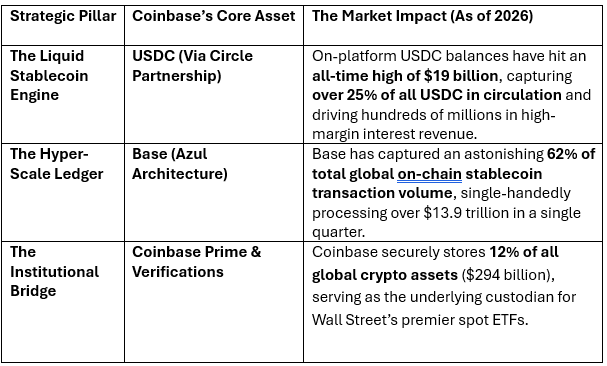
Coinbase has effectively won the race because they realized early on that a financial operating system requires three pillars to succeed: Liquidity, Ledger, and Compliance.
3. The Future Moat: Capturing the Agentic Economy
While retail adoption of Web3 applications can still feel fragmented to the casual observer, Coinbase has quietly cornered the ultimate future growth market: Autonomous AI Agents.
As generative AI models increasingly look to execute economic transactions independent of human intervention, they cannot use traditional credit cards or legacy bank accounts. They need programmable, lightning-fast digital cash. Coinbase engineered the perfect sandbox for this via Base’s sub-second “Flashblocks” and the open x402 AI-to-AI payment protocol.
In the early months of 2026, over 90% of all on-chain agentic stablecoin transactions occur natively on Base, with 99%+ settled using USDC.
An AI agent doesn’t care about blockchain tribalism, marketing campaigns, or flashy logos. It routes to the platform that provides the lowest transaction friction, the tightest security, and the deepest liquidity pools. By capturing the underlying infrastructure for automated machine commerce today, Coinbase is guaranteeing its volume dominance for the next decade.
The Irreversible Network Effect
When a tech giant achieves this level of vertical integration, a powerful flywheel takes over:
Every month Base spends as the leading Layer 2 layer expands Coinbase’s advantage. Fintech startups and neo-banks build on Base because that is where the USDC liquidity lives. Users stick with Coinbase because their biometric Passkey Smart Wallet works everywhere flawlessly. Wall Street chooses Coinbase because they are the only entity that can bundle SEC-grade asset custody with sub-cent settlement rails.
By refusing to specialize in just one area, Coinbase has built a vertically integrated financial fortress. They own the onboarding ramp, the legal identity layer, the stablecoin currency, the primary execution network, and the institutional custody vault. The adoption lag is simply the time it takes for the rest of the world to realize that the operating system for the future of global finance has already been built.